

Solution

Biomedical Applications
Terahertz technology holds transformative potential for the future of biomedicine, offering a unique, non-invasive window into biological tissues and processes. Its non-ionizing radiation can safely penetrate many non-conductive materials and is highly sensitive to water content and molecular vibrations. This enables label-free, high-contrast imaging for early-stage disease diagnosis—such as detecting skin cancers, dental caries, and burned tissues—based on their distinct terahertz signatures.
Beyond imaging, terahertz spectroscopy provides groundbreaking tools for precise pharmaceutical analysis, including the characterization of crystal forms in drug formulation and real-time monitoring of tablet coating uniformity. Looking ahead, continuous advancements in compact, high-sensitivity terahertz systems will drive its integration into clinical and laboratory settings, paving the way for next-generation diagnostic platforms, in vivo monitoring, and personalized medicine.
CASE 1: The 3D tomography and reconstruction software
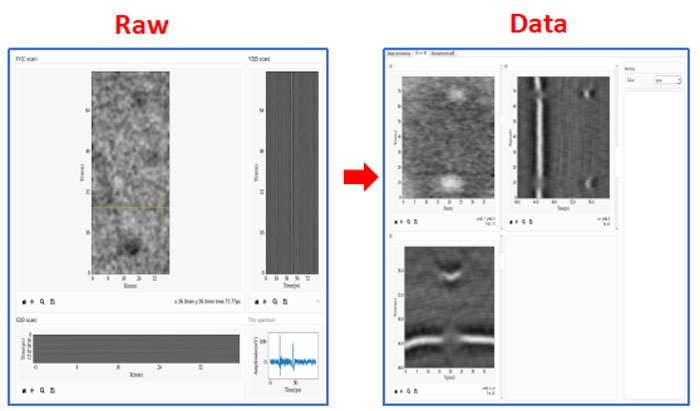
The 3D tomography and reconstruction software for terahertz non-destructive testing is a powerful tool designed to visualize and analyze the internal structure of materials or objects without causing any damage. This software enables the reconstruction of three-dimensional images from a series of two-dimensional terahertz images captured at different angles. It is particularly effective in identifying internal defects such as cracks, voids, inclusions, and delaminations that are not visible to the naked eye or through traditional inspection methods.
One of the key features of this software is its ability to perform defect identification, allowing users to detect and locate anomalies within the sample with high precision. The system uses advanced algorithms to process the terahertz data, enhancing contrast and resolving fine structural details, which is especially valuable in quality control and failure analysis of complex materials and components.
Another important feature is image and spectrum integration. This means that the software not only provides spatial imaging data but also integrates spectral information from the terahertz signals. This dual capability allows for a more comprehensive analysis of both the physical structure and the material properties of the sample. For example, it can distinguish between different materials based on their unique terahertz spectral signatures, which is particularly useful in multi-layered or composite structures.
This type of software is widely used in various industries, including semiconductor manufacturing, aerospace, electronics, pharmaceuticals, and materials science. It supports both research and industrial applications by enabling fast, accurate, and non-invasive inspection of critical components and materials.
Related Solutions


Related News

AI-Powered Terahertz Inspection Platform Exclusively for Aerospace MRO---TERA X1
Built specifically for aerospace aircraft maintenance scenarios, it leverages terahertz non-destructive testing principles to accurately measure coating thickness and detect hidden defects in multi-layer structures at an early stage, safeguarding aircraft safety.
Continue Reading

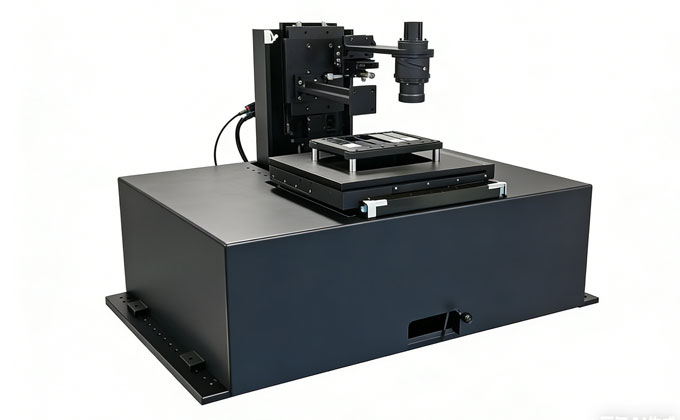
Introducing TerraScope™ Ultra: 3D Terahertz Intelligence at the Wafer Scale
TerraScope™ Ultra:Unified Broadband 3D Terahertz Platform for Extreme-Range Carrier, 2DEG & Full-Wafer Semiconductor Intelligence
Extreme-Range Carrier Analysis: Precisely maps carrier density, mobility, and lifetime across various doping levels and multilayer structures with high resolution and deep penetration.
Continue Reading